

Interview with Renee Karabash: "There Is Nothing Shameful About Being Vulnerable or Sensitive"

Jasmina Tacheva speaks with Renée Karabash - writer, playwright, screenwriter, and founder of the Zaeshka Dupka Writers’ Academy. Her novel She Who Remains [Ostaynitsa] gained international recognition and brought Bulgarian literature and art to audiences around the world after being shortlisted for the prestigious International Booker Prize earlier this year. Audiences will soon also encounter the story through its forthcoming film and stage adaptations. We discuss the importance of finding our way back to ourselves and of making space for the rest that creativity requires, as well as the responsibility that comes with having a public platform, and why women and vulnerable communities are so often turned into convenient targets while deep-rooted family and social traumas remain unnamed. We also talk about art as a way of processing pain and bringing healing to both ourselves and others; about loving oneself and another person; and about Karabash’s latest poetry collection, Someone Is Calling Me by Name [Niakoi me vika po ime]; and the upcoming courses at the Zaeshka Dupka Writers’ Academy.
I. From an Internationally Acclaimed Novel to Stage and Screen
Hello, Rene. Where are we finding you today?
I’m in Sofia at the moment, though only for a few days. I live here, but I travel a great deal and, unfortunately, rarely manage to stay very long. Right now, I’m at home, waiting for next week, when I’ll leave for the seaside. I’ll be there until September.
You’ve said that writing a novel takes a great deal of discipline and solitude. Will you be working on your second novel while you’re at the seaside?
First, I need to rest, because I don’t believe an artist can create anything without first returning to themselves. Once I’ve had some time to recharge, I plan to continue working on the stage adaptation of She Who Remains, with director Stayko Murdzhev. We are planning to produce the play in Sofia. Of course, I’ll also continue writing the novel, though I have no idea how long it will take. It may require considerably more time, as it is much longer than She Who Remains.
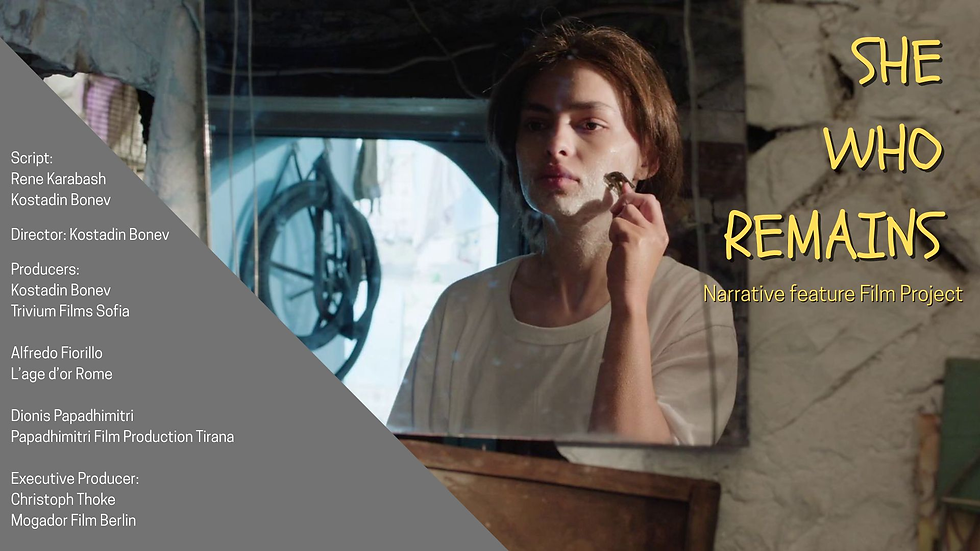
The film adaptation of She Who Remains, directed by Kostadin Bonev, has also been completed. When can audiences expect to see it?
I hope the film will be released in Bulgaria by the end of the year. Its Bulgarian premiere will most likely take place at the Golden Rose Film Festival in Varna, after which it will travel to other festivals around the country. Before that, however, it is expected to have its world premiere at an international film festival. We are still waiting to find out where that will be.
Are there significant differences between adapting the novel for film and for the stage?
Of course. They are different art forms, each with its own language and particular demands. I did not find it especially difficult to turn the novel into a screenplay because my writing is already very cinematic. I see everything in images and scenes, almost as if I were watching a film, and then I simply decide how best to tell the story, whether as a novel, a play, or a film. I’m currently drawing on both the novel and the screenplay as I write the stage adaptation, since many elements have already been translated into action in the script. The novel, by contrast, is written as a stream of consciousness - we spend the entire time inside the protagonist’s mind. A whole film cannot unfold through voice-over, so we had to find a way for the story to come alive on screen.
II. On Finding Our Way Back to Ourselves
How do you manage to preserve a sense of inner calm amid all the travel and public attention?
It’s not easy. It requires a great deal of self-awareness. When I’m on a long tour, with events every day in different cities, I always try to set aside time for myself to meditate, breathe, and quiet my mind. I see this as an essential form of personal hygiene for anyone whose daily life is especially intense or demanding. It’s very easy to lose yourself in all the noise, the constant movement, and the endless encounters with other people, and to forget who you are. I have done a great deal of work on and with myself, and I can honestly say that I am happy with the results and with how I feel. Of course, I also need physical rest. The body has no other way to recover.
You often say that, before we can love others, we must first accept and love ourselves and learn how to care for ourselves. How did that journey begin for you?
It began with a profound rupture in my life, after a very difficult relationship. In the aftermath, I started asking myself why this had happened to me. I started working with therapists and exploring spiritual and esoteric literature, occult alchemy, as well as exploring different approaches to understanding the inner roots of what happens in our outer lives. Because before something happens outside us, in some sense it has already happened within us. If someone abandons us, perhaps we have already abandoned ourselves. I see other people as mirrors. Before blaming someone for something they have done to me, I always try to reflect on whether I may have first done the same thing to myself. I try to give myself what I need before looking for it in someone else.
Is that process difficult in a region where there is still so much stigma around emotional and psychological well-being?
I don’t think this is limited to our region - it exists all over the world. The process is not easy, and it continues as long as we are alive. We are constantly being given lessons, and it is up to us whether we learn from them or have to repeat them, and whether the same experiences continue to affect us in the way they once did. We live in an age of overwhelming information. There is an abundance of self-help literature, and many of us go to therapy, spiritual seminars, and retreats. But there is also a danger that these resources can become a crutch. It’s very easy to hide in them. The real challenge is to eventually free yourself from everything and truly stand within yourself - to be free, without gurus, mentors, or crutches. To be able to live as yourself, calmly and authentically among other people. That is a major challenge, but it is not impossible.
So there is no magic pill - you simply have to live through the process?
Whoever invents that pill will become the richest person in the world. There really is no other way. But I have also become aware of another danger. My generation, and the generations before us, were never taught how to love and respect ourselves, or even how to recognize our own boundaries. Now, as adults, we have to learn where those boundaries lie, how to care for ourselves in a meaningful way, and how to love ourselves. To some extent, that can make us more individualistic. Sometimes, in order to protect yourself, you have to draw a boundary, and that may hurt other people, including those closest to you. The challenge is not to go to the opposite extreme and become overly individualistic or selfish, because the line between the two can be very fine. We still live in relationship with other people. Sometimes it’s good to make a sacrifice for someone else, to do something kind, and to put yourself second. That, too, is a form of strength.
Yes, you often say we’re all connected, like “pieces of one greater soul.” Does that mean we have a responsibility not only to ourselves, but to society as well?
Yes, absolutely. This is especially true for people who have a public platform and the opportunity to reach a wider audience. I, for instance, feel a great sense of responsibility whenever I speak in front of people or through the things I write. We need to think carefully about how we speak and, at the most basic level, about the language we choose to use.
III. On Human Rights and the Position of Women
In that sense, a few days ago, from perhaps the most powerful public platform in Bulgaria - the National Assembly - the governing parties declared that protecting the “traditional family” was a matter of national security. Is this not one of those rules of the Kanun in She Who Remains - rules “that must not be questioned” and that prevent entire communities from living as themselves?
Unfortunately, there is such a tendency in Bulgaria, and we all know when it began to intensify. It’s not like these attitudes didn’t exist before, but today they can spread far more easily. What is especially troubling is that institutions such as the government and the Church are lending them their support and using their influence to shape public attitudes. If you have a healthy family - “traditional,” or whatever we choose to call it - you should not feel threatened by anyone else. But politicians know how to exploit the vulnerabilities and fears of particular communities. It is also deeply troubling that religion is being used in this way. Religion should be a source of support and connection, not a tool for dividing people. We have seen this model used in other countries. Bulgaria is part of the European Union, but unfortunately it still has a very long way to go. I don’t think we should simply accept what is happening. Every sign of this tendency should be challenged - through protest, through clearly expressed public positions, and at the very least by the political opposition, from which, quite honestly, I heard almost nothing on the matter.
Would it be fair to say that violence against women, homophobia, and transphobia all share a common root?
Oh yes, absolutely, although the matrix behind them is extremely complex. Meanwhile, femicide and the broader treatment of women remain deeply serious issues. In Bulgaria, when someone uses the words “feminism” or “feminist,” they are often treated almost as insults, associated with “hysterical” or “hormonally unbalanced” women. But feminism is about women and movements fighting for women to have equal rights, not more rights than anyone else, simply equal ones. It is because of the women who fought for generations that women today can vote, receive equal pay, and hold positions of power. Yet some of the very women who benefit from those struggles now say that they are not feminists. In the United States, there are now even calls to take away women’s right to vote, while abortion has already been banned or severely restricted in several states. A man is going to decide what happens to my body - whether I give birth or not? And what if a woman has been raped? Is she supposed to carry the pregnancy to term because she could otherwise be punished for having an abortion? We are moving decades backward, and things are not getting better.
This is an especially important reminder for all vulnerable communities, including queer people: rights are not simply given to us; they are won through struggle. And they are never guaranteed once and for all - they can be taken away at any time…
Exactly. The media do not help either, particularly through their use of the word “parade,” which suggests showing off or flaunting something. Homophobes often say, “I don’t want them parading around here.” But Pride is not about flaunting anything. I have also noticed that the media often deliberately select images of the most visibly eccentric-looking participants. Yet queer people look and live in countless different ways. Homophobic people live alongside LGBTQ+ people every day, often without even realizing that the person next to them is queer. So the media are not helping us address the problem. We also know that very few media outlets in Bulgaria are genuinely independent, among them Vechernitsa and Svobodna Tochka. Freedom of expression is also in a very precarious state. I don’t know whether, in the near future, a law might be passed that would ban my book or make me liable for having written it. Nor do I know whether I would still be free to write a similar book again.
Which responses from readers have affected you most deeply?
I receive letters and messages from readers all over the world every day. I can’t point to one particular message as my favorite, but the most powerful are those in which people tell me that the book has, in some way, saved their lives, that it helped pull them out of a dark place or carry them through a difficult period. That means a great deal to me, because ultimately I believe this is what art is meant to do: to heal people, not make them ill.
Did seeing the Balkans through your readers’ eyes change the way you understand the region?
I see the novel as a global story - one that is broadly human and universal. On the surface, it may appear local and distinctly Balkan, but on a symbolic level it reflects the everyday reality of many women who are forced to survive in a man’s world. The only way they can do so is not by literally becoming men, but by drawing more heavily on what we might call masculine energy and taking on traditionally masculine roles, particularly in the Balkans. Here in Bulgaria, those roles are often deeply distorted. Women become mothers not only to their children, but also to their fathers and husbands. Many men project the figure of their mother onto their partner and expect her to care for them, go to work, raise the children, put dinner on the table every evening, and manage everything else, while they simply come home from work and go to bed. To some extent, I also think it depends on women - on what kind of treatment they are willing to accept. The problem begins with the small things. Then the larger ones follow, until eventually you reach the suitcase at the door.
How did you first come across the story of the sworn virgins?
Quite by chance. I came across an exhibition in Bulgaria by the photographer Pepa Hristova and was deeply struck by the women’s androgyny and by the way everything traditionally perceived as feminine had been erased from their appearance. To me, there is a powerful metaphor in the way they look and in what they were compelled to become.
In a sense, to succeed in a man’s world, women are expected to suppress the feminine?
Yes, unfortunately, we are often forced to do exactly that. But why can’t we simply exist with dignity as women? Why must men perform this kind of destructive masculinity? I have never heard of a woman starting a war against another country. Of course, there are cases in which women kill their partners, but they are far less common and often occur after the woman has endured violence at his hands.
Your novel is one way of challenging the patriarchy causing all that. What else needs to change?
Patriarchy needs to be dismantled at its roots, and that will probably take several generations. Every current or future parent needs to work seriously on themselves, through therapy or in whatever ways are available to them, so that they do not pass inherited trauma on to their children. Everything begins with parents. When a child sees how a man treats a woman, that relationship becomes a model the child absorbs. In Ireland, there are classes where children learn how boys and girls should relate to and respect one another. They are also taught how important it is for boys to be allowed to feel, to be sensitive, and to cry. In Bulgaria, boys are often told, “Come on, be a man,” “Tough it out,” or “Act like a man.” When emotions are continually suppressed, they turn into anger and aggression. But we are all human beings, we all have emotions, and there is nothing shameful about being vulnerable or sensitive. There are many problems, but I believe they all begin with the family. That is why we need to work on ourselves, especially if we are planning to become parents or hope to have children one day. We should constantly ask ourselves what kind of example we are setting for them.
Where do you find a sense of calm amid the noise of Sofia?
I have been living in kvARTal for about a year now. I lived here ten years ago as well, but this time I have a home of my own. Recently, I found myself thinking that the neighborhood feels like a small village. My street is very quiet and lined with beautiful buildings. When I look out of my window, I can see what feels like the center of this little village around the Cinema House [Dom na kinoto]. I watch the rhythm of daily life - people passing by, filling bottles with water, going to the cinema, meeting one another, and it gives me a sense of comfort. I also run into many people here I would find difficult to see elsewhere in the city, usually artists. Almost every time I go out, I greet someone I know. There is an older woman who lives nearby and walks her dogs, and we always say hello to each other. It feels a little like living in the countryside: you know almost everyone, and there is a genuine sense of community. What I love most is that it is an old neighborhood. I am drawn to vintage objects, old places, and historic buildings. The atmosphere is different, and somehow it carries me back to another time, perhaps one in which I may have lived once.
On Rene’s Newest Book and the Zaeshka Dupka Writers’ Academy
Your latest book, the poetry collection Someone Is Calling Me by Name, came out just a few months ago. Why did you decide to include rhymed verse in this collection?
I had wanted to include these poems for a long time. Readers know me primarily for my free verse, but I sometimes write in meter as well. Eventually, the time felt right, and I had written enough of these poems for them to form a cycle within the new collection. Some of them date back to the very beginning of my life as a poet. That is one reason this book feels so personal to me: writing in rhyme is also an important part of who I am, but it is a side of my work that I had not previously shared with my readers.

I particularly wanted to ask you about “Panopticon,” which is one of my favorite poems in the book. Is it one of the earlier or more recent pieces?
It’s one of the more recent poems. The book contains an entire cycle written over the course of last year, which was a deeply cathartic period for me.
Through the lens of that catharsis, do you think love always goes hand in hand with suffering?
True love? No. But it depends on what kind of suffering we mean. If we’re talking about the masochistic suffering of a toxic relationship, where you are in pain but believe that you love the other person, then that is not love. True love also goes through difficult periods. A relationship involves two people, and each of them experiences personal crises that inevitably affect the relationship. The question is how you move through those crises without losing what you have together. There will be moments when things are very difficult. But when two people are moving in the same direction, and both are willing to fight for the relationship and to work on themselves, I think that is love. Above all, love is being with someone who helps you learn to love yourself.
So it is about seeing the relationship in the long term, rather than being guided only by immediate desire?
Yes. The most passionate desires and relationships are often like a fire that flares up intensely but burns out just as quickly. Perhaps there is more meaning in the kind of love where the flame is not as dramatic, but you keep it alive like an Olympic flame that never goes out. Because what remains after the other kind of fire? Ashes. And you can’t rekindle the same flame from ashes.
Which of the two is more inspiring for poetry?
That depends on what inspires a particular writer. I write a great deal when I am going through a difficult period - it’s one of the ways I process what I am feeling. But I also write a lot when I am in love. In the space between those two states, I either don’t write much or find inspiration in things outside the relationship, in what I notice around me.
What is coming up for the Zaeshka Dupka Writers’ Academy you’re the founder of?
I’m currently preparing the Academy’s fall program. Applications are already open for all of the courses beginning in October. We will continue offering our regular courses in prose, poetry, therapeutic writing, and fantasy, but this year we are also launching two new programs that I find especially exciting. The first is a crime-writing course led by Emil Minchev and Alexander Chobanov, one of Bulgaria’s most prominent crime writers and screenwriters. The course will also feature guest lecturers, including criminal psychologists and other professionals from the field. The second new course focuses on therapeutic kintsugi - the Japanese art of repairing broken pottery with gold. A wonderful therapist has developed and patented a process that uses this practice as a way of working through trauma. Anyone who would like to strengthen their writing, meet inspiring artists, and become part of a community that continues long after the Academy has ended is very welcome to join us.

How can people apply?
They can apply through our website or contact us through our Instagram or Facebook pages. All they need to do is email us a writing sample, a few words about themselves, and the name of the course they would like to join. The courses meet twice a week for two months and take place after working hours, from 6:30 to 8:00 p.m. We offer both in-person and online options, as our participants come not only from Sofia and other cities across Bulgaria, but also from other countries, which is wonderful. We support all participants who would like to publish a book, because finding your way to the right publisher is far from easy.
Speaking of publishing, I know you have been presenting Someone Is Calling Me by Name in different parts of the country.
I have been touring Bulgaria and presenting the book in a number of cities. This Sunday, June 21, I will be in Plovdiv. After that, I will take a short break, although several more events are planned for the summer. On July 21, I will take part in the Art Stream Festival in Lozenets at By the Way. The event will be moderated by journalist Georgi Toshev. Then, on September 2, I will present the book at the Apollonia Festival of Arts in Sozopol. Everyone is warmly invited to join us for these seaside book presentations.
Where can readers find the latest information about your upcoming events and projects?
Thank you for this conversation.
Interview by Jasmina Tacheva


Comments